
Microsoft Cancelled Claude Code the Week Anthropic Hit $965 Billion. Their CFO Just Told a Federal Judge Lifetime Revenue Is $5 Billion. This Is What an AI Bubble Looks Like.
The bubble's first crack isn't a model that stopped working. It's an enterprise CFO that started reading the bill. Microsoft is the first. The Build keynote on Tuesday is the reply. The IPO at $1.5 trillion in 2027 is the trade.

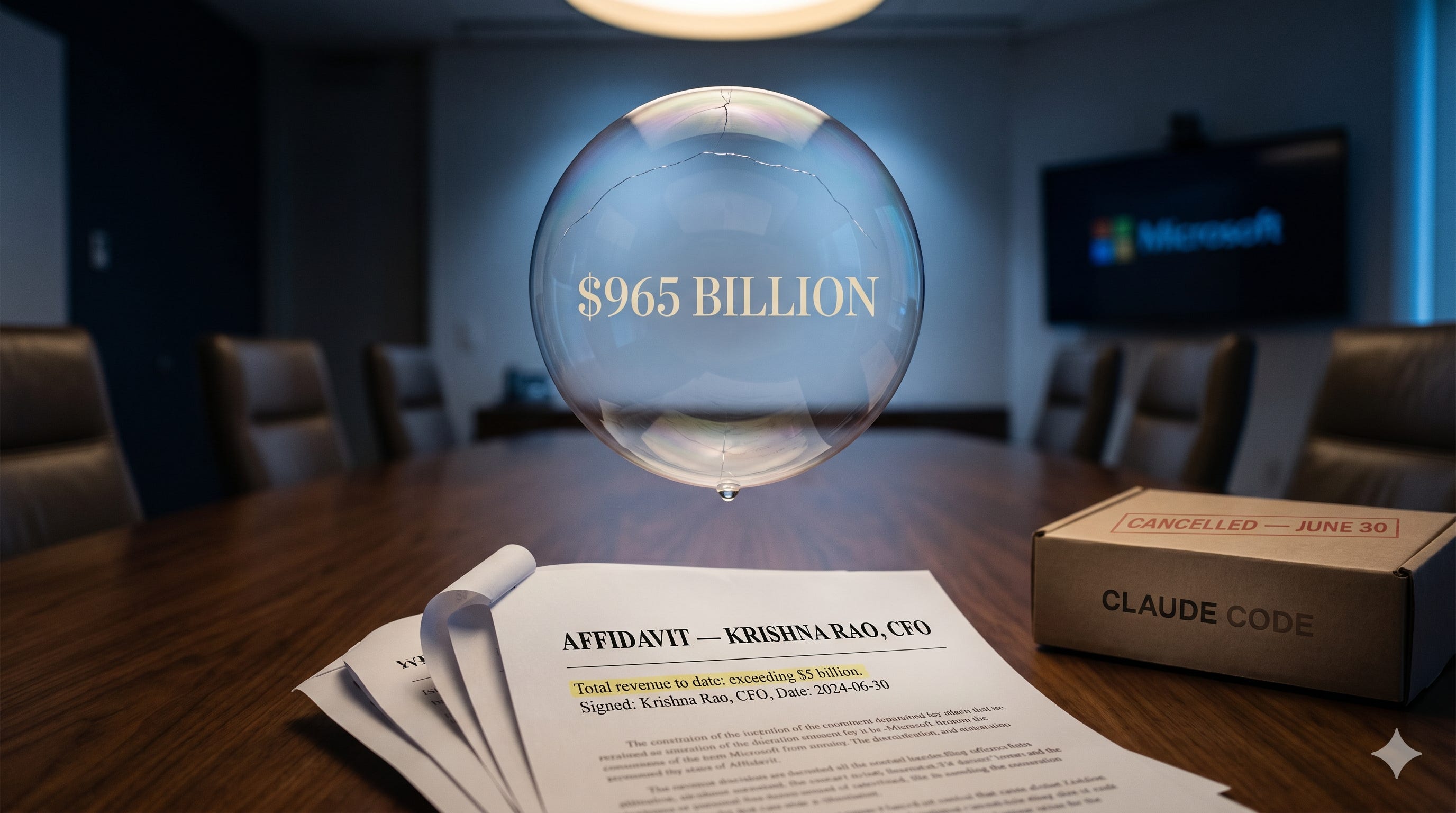
Three things happened in the last fourteen days. Two of them are everywhere. The third is the one that matters.
On May 15, Microsoft cancelled internal Claude Code licenses for thousands of its own engineers across Windows, Microsoft 365, Outlook, Teams, and Surface. Hard cutoff: June 30, the close of Microsoft’s fiscal year.
On May 28, Anthropic closed a funding round at a $965 billion post-money valuation, surpassing OpenAI as the world’s most valuable AI company for the first time.
On May 28-29, The Information reported Microsoft will unveil a homegrown coding model at Build next Tuesday, explicitly built to replace Claude inside GitHub Copilot. Microsoft stock popped 3% on the news.
You’re being told these are three separate stories.
They’re one story.
The court filing nobody read
On March 9, 2026, Anthropic’s CFO Krishna Rao filed a sworn affidavit in the company’s lawsuit against the Department of Defense. The affidavit stated that Anthropic’s total lifetime revenue — every dollar earned from the company’s founding through that filing date — was “exceeding $5 billion.”
Five billion dollars. Total. Across every year of Anthropic’s existence.
In the same window, the company tells investors and the press it’s running at $44 billion annualized. Q1 2026 alone is claimed at $4.8 billion. Q2 projection: $10.9 billion.
The math does not add up. To believe both numbers, you have to believe Anthropic processed roughly 85% of its entire lifetime revenue in the last 100 days.
Ed Zitron has been the only person publicly pointing at the gap. His summary: either the CFO understated revenue to a federal judge, or the numbers Anthropic is shopping to investors are inflated. There is no third option that makes both claims true.
This filing is not buried. It is public. It is on the docket. And the same company that filed it just took the largest private financing check in technology history at a near-trillion-dollar valuation.
What Microsoft actually did
Read Rajesh Jha’s internal memo from May 15 and you are told it is a “benchmarking-then-convergence” decision. Microsoft’s Experiences and Devices org tested both Claude Code and GitHub Copilot CLI side by side. The framing: Microsoft can shape Copilot CLI directly with GitHub, so they are consolidating.
That is the corporate version.
The actual version is in the bills.
Inside Microsoft, thousands of engineers had been using Claude Code daily since December 2025. The internal comparisons reportedly favored Claude over Copilot CLI on real engineering tasks. Engineers preferred the tool Microsoft is now forcing them to stop using.
Why? Look at Uber. Uber deployed Claude Code to roughly 5,000 engineers. By April 2026, monthly active usage was 84-95%. Individual engineers were spending $500 to $2,000 per month on API tokens.
That is not a software tool. That is a salary line item.
Microsoft is the largest software employer on earth. If their numbers looked anything like Uber’s, the internal Claude Code bill across Windows, M365, Outlook, Teams, and Surface engineering was in the eight to nine figures per year — and rising every month, because the better the tool gets, the more developers use it.
The Next Web’s framing was the most honest one I read: the tool was cancelled because engineers used it too much.
This is the first time an enterprise buyer at Microsoft’s scale has publicly capped Anthropic spend. The next ten Fortune 500 CFOs running the same math will not need their own internal memo. They have Microsoft’s.
The valuation is funded by the bill Microsoft just refused to pay
Fourteen days after the Claude Code cutoff began, Anthropic closed at $965 billion post-money. Up from $380 billion in February. Up from $61.5 billion in March 2025. Anthropic now sits ahead of OpenAI’s $730 billion private valuation for the first time in the AI race.
The story sold to investors is straightforward. Claude Code is the fastest-growing developer tool in history. Enterprise demand is exploding. Run-rate revenue is $44 billion annualized. The IPO at Q1-Q2 2027 lands at a multi-trillion-dollar market cap.
The piece nobody is connecting on the same investor deck: that $44 billion run-rate is the same bill Microsoft just told its own engineers to stop running up.
Anthropic’s valuation is funded by enterprise revenue from a tool whose unit economics broke the biggest enterprise customer they ever had. That customer is still paying them on the side — the November 2025 Foundry deal ($45 billion, Microsoft + NVIDIA + Anthropic) is still live, Claude models still power Copilot Cowork in M365. But the internal usage was capped on May 15.
Anthropic’s CFO told a federal judge they had made $5 billion in lifetime revenue. Two months later they took a check that values them at $965 billion. The two facts don’t reconcile. One of them is wrong.
The economics nobody talks about
Anthropic has spent over $10 billion on training and inference. The CFO’s affidavit says they have generated $5 billion in revenue all-in. That is $2 of compute spend for every $1 of revenue earned across the company’s lifetime.
For consumer subscriptions, the ratio is reportedly worse. One analyst framing: Anthropic was letting users burn $8 in compute for every $1 of subscription revenue.
This is not a business. It is a venture-subsidized growth experiment that depends on the next round closing before the last round’s cash runs out. Every round so far has closed. The May 28 round was reported as the largest private financing round in technology history.
Bill Gurley, the Benchmark partner who called the late-1990s telecom bubble, put it bluntly in March: one day the music stops.
Total Big Tech AI capex in 2026 is projected at $700 billion. Gurley has compared this to Uber’s $2 billion annual burn that gave him “high anxiety” in 2015. Today’s AI burn is roughly 350x that. He calls the next phase a reset.
The Bank of England has warned of correction risk from AI overvaluation. A National Bureau of Economic Research study published in February 2026 found that 90% of firms reported zero impact of AI on workplace productivity — even as executives projected a 1.4% productivity gain across the same survey.
Nine out of ten firms see no productivity lift. The flagship enterprise customer just capped its spend. The CFO filed a number to a federal judge that contradicts the investor pitch by an order of magnitude.
This is what an AI bubble looks like before it breaks.
Tuesday at Build: the reply
Microsoft Build 2026 runs June 2 to June 3 in San Francisco. The first time the conference returns to the city since 2016. Roughly 2,500 developers in person at Fort Mason. Satya Nadella opens; Scott Guthrie carries the enterprise vision. Mustafa Suleyman, CEO of Microsoft AI, holds the agentic coding throughline.
Suleyman is the figure nobody is naming.
He was banned from training top-tier frontier models under the old OpenAI deal until April 2026, when Microsoft renegotiated the contract that allowed OpenAI’s for-profit conversion and unlocked Suleyman’s restrictions. His MAI Superintelligence team — built from DeepMind, Meta, OpenAI, and Anthropic researchers — has been heads-down ever since.
The coding model Microsoft unveils on Tuesday is Suleyman’s first frontier shot post-ban.
The strategy is not technical leadership. It is price leadership.
GitHub Copilot has lost serious ground. Stack Overflow’s 2026 Developer Survey put Copilot’s developer share at 51%, down from 67% a year ago. Among paying Microsoft Copilot subscribers, share dropped from 18.8% to 11.5% in six months. JetBrains’ 2026 report has Claude Code preferred by 46% of senior developers versus Copilot’s 9%.
Microsoft cannot win this on quality in one product cycle. They can win it on cost.
If Microsoft prices the new coding model at 30-50% below Claude Code per token — which is the only pitch that justifies forcing thousands of internal engineers off Claude — it triggers a price war. Anthropic’s margins compress. The next Fortune 500 CFO running the Uber math has a cheaper alternative.
Tuesday is the day to watch for one number: the per-million-token price.
The IPO is the trade
Anthropic’s S-1 has not been filed. The expected window is Q1-Q2 2027. Goldman Sachs, JPMorgan, and Morgan Stanley are the rumored leads. Wilson Sonsini is counsel.
OpenAI filed confidentially in early 2026. Their target is Fall 2026. They could beat Anthropic to public markets by six months.
Anthropic at IPO will likely price between $1.2 and $1.5 trillion. That math requires Claude Code to keep compounding at the rate that justifies the May 2026 valuation jump. It requires the next 50 Fortune 500 CFOs to not do what Microsoft just did.
Here is the prediction.
Anthropic prices at roughly $1.4 trillion in March 2027. The first 90 days trade flat to up 10% — every IPO has that honeymoon. By Q3 2027, the second and third Fortune 500 enterprises file internal Claude Code spending reviews. By Q4 2027, the stock is down 25-35% from the IPO price. By Q2 2028, the post-mortems compare Anthropic to Pets.com — IPO’d at the peak, unraveled within four quarters as the unit economics finally surfaced.
The bubble does not pop when models stop working. The bubble pops when enterprise CFOs read the bill. Microsoft just read. They told the world by canceling Claude Code internally on May 15. They will tell the world again by pricing the alternative on June 2-3.
If you are an LP in Anthropic’s secondary, the trade is to sell into the IPO. If you are an enterprise architect betting your stack on Claude, the trade is to plan for portability — write your prompts and your agent harness so that swapping Claude out in 2027 is a Friday afternoon, not a quarter-long project. If you are a developer who actually prefers Claude (and from the data, most senior developers do), the trade is to bookmark this piece and re-read it in eighteen months.
What I am watching this week
Three signals between now and June 30.
Tuesday, June 2: the price per million tokens that Microsoft posts for the new coding model. Anything more than 30% below Claude Code is a price war declaration.
Tuesday, June 2: whether Mustafa Suleyman names Anthropic on stage. Suleyman has been muted publicly for two years. If he names the competitor, this is a different kind of company moving forward.
June 30: whether any Microsoft engineering team publicly begs for a Claude Code extension. If they do, the convergence story collapses and the cost story becomes undeniable.
The thing nobody is saying
Anthropic is the best model company on earth right now. Opus 4.8 is the most capable agentic coding tool that has ever existed. Dynamic Workflows let Claude Code refactor codebase-scale migrations across hundreds of thousands of lines with the existing test suite as its bar. If you are a builder shipping code today, you should be using Claude.
None of that fixes the math.
A $965 billion valuation requires revenue that justifies a $965 billion valuation. The CFO’s court filing says the revenue is not there yet. The investor pitch says it is. Microsoft’s internal cancellation says the unit economics are not there yet. The Build keynote on Tuesday says Microsoft has a cheaper answer ready.
There is no version of this story where all four of those facts are true at the same time. One of them breaks.
My bet: the valuation breaks. In 2027.
References
Anthropic Eclipses OpenAI With Valuation of $965 Billion — Bloomberg
Anthropic Told Court $5 Billion But Public $19 Billion — flyingpenguin
Microsoft Shifts Engineers from Claude Code to GitHub Copilot CLI — WinBuzzer
Microsoft starts canceling Claude Code licenses — Hacker News
Microsoft to Release New Coding Model Next Week — The Information